News

Drought Planning Groups Across State Urge Public to Conserve Water
April 28, 2026
 Drought Planning Groups Across State Urge Public to Conserve Water
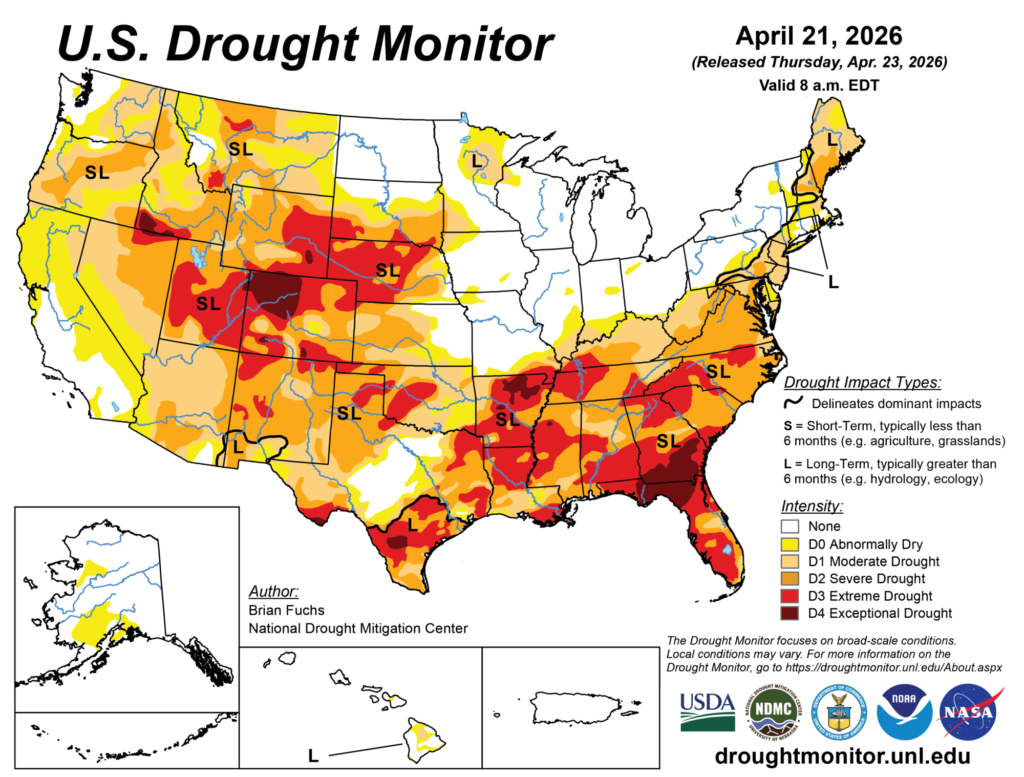
The Platte Basin Coalition, the Lower Platte River Drought Consortium, the Republican River Natural Resources Districts (NRDs), and the Nebraska Department of Water, Energy and Environment (DWEE) are urging the public to utilize water conservation best practices due to ongoing drought conditions across Nebraska. As of April 21st, the National Drought Mitigation Center reports that 43% of the state is experiencing extreme drought (D3), 43% is experiencing severe drought (D2), and 12% is experiencing moderate drought (D1). While recent rainfall has provided some relief, it has not been sufficient to significantly improve overall conditions.
Nebraska’s population relies heavily on both surface water and groundwater replenished by surface water for agricultural, municipal, domestic, and industrial use. With precipitation patterns that are highly seasonal, the late spring and early summer months are critical for replenishing soil moisture, streamflow, and groundwater supplies. Ongoing drought conditions mean that even near-normal rainfall may not fully offset existing deficits.
According to NOAA Climate Prediction Center’s Seasonal Drought Outlook, average drought conditions are expected to persist or likely worsen across Nebraska this spring and summer despite occasional short-lived relief.
Water-Saving Practices
In response, Central Platte Natural Resources District (CPNRD) encourage producers and residents to adopt practical water conservation strategies, including:
Irrigation Management
- Schedule irrigation based on crop needs to avoid overwatering
- Utilize tools such as soil moisture monitoring and evapotranspiration estimates
- Apply water during critical crop growth stages to maximize efficiency
Precision Irrigation Technologies
- Use sensors and software to determine when and how much to irrigate
- Improve efficiency and reduce water waste through targeted applicationExamples include:
- Flow meters
- Soil moisture probes
- Variable Rate Irrigation (VRI) systems on pivots
- Remote telemetry systems for real-time data
Soil Health Practices
- No-till or reduced tillage to retain soil moisture
- Planting cover crops to improve soil structure and water retention
These practices help conserve water, improve efficiency, and support long-term groundwater sustainability.
Public Reporting & Resources
To improve drought monitoring across the state, the public is encouraged to submit drought-related observations through the Condition Monitoring Observer Reports (CMOR) system maintained by the National Drought Mitigation Center:
https://droughtimpacts.unl.edu/Tools/ConditionMonitoringObservations.aspx
https://droughtimpacts.unl.edu/Tools/ConditionMonitoringObservations.aspx
Consistent public reporting helps inform the development of the weekly U.S. Drought Monitor. For current drought conditions and available assistance programs, visit:
- U.S. Drought Monitor: https://droughtmonitor.unl.edu/
- USDA drought assistance programs: https://www.farmers.gov/protection-recovery/drought
- Nebraska Department of Agriculture Drought Resources: https://nda.nebraska.gov/drought
The drought planning groups will continue to monitor conditions and provide updates on basin-wide impacts. Residents are encouraged to contact their local NRD for additional conservation practices and resources.
Platte Basin Coalition
The Platte Basin Coalition was formed in 2012 by NRDs in the Upper Platte River Basin and DWEE to jointly implement water management projects and address drought-related challenges.
Coalition partners include:
- Central Platte NRD
- North Platte NRD
- South Platte NRD
- Tri-Basin NRD
- Twin Platte NRD
- Nebraska Department of Water, Energy and Environment
Upper Platte River Drought Contingency Plan – Current Status
- Basin-Wide Area: Drought Alert
- North Platte River Above Lake McConaughy Subarea: Drought Alert & Water Supply Advisory
- South Platte River Subarea: Drought Alert & Water Supply Alert
- Platte River Subarea: Drought Alert
As of April 21st, approximately 34% of the Upper Platte Basin is experiencing severe drought (D2), and 66% is experiencing extreme drought (D3).
For updates on drought triggers and response actions, visit:
https://dnr.nebraska.gov/water-planning/upper-platte-river-drought-contingency-plan
https://dnr.nebraska.gov/water-planning/upper-platte-river-drought-contingency-plan
-
Main Office
- 215 Kaufman Ave, Grand Island, NE 68803 308-385-6282
-
Cozad Office
- 75887 Road 414, Cozad, NE 69130 308-380-8943
-
NRCS Field Offices (Ext. 3)
- Central City 308-946-3035
- Kearney 308-237-3118
- Grand Island 308-395-8586
- Lexington 308-324-6314
- Osceola 402-747-2111

-
Quick Links

© 2026 Central Platte Natural Resources District
